
What is The American Dream?
Ask a dozen different people to define the American Dream and you will likely receive a dozen different answers4.
Most people do seem to be able to define a version of it for themselves. The paradox arises only because the symbols of the American Dream are not the dream any more than a diploma is an education or a wedding ring is a marriage.
To understand the American Dream in its fullness, we must look beyond its symbols and examine the conditions that make it possible, the aspirations that give it meaning, and the mindset that shapes its pursuit.
While no framework can fully capture something as personal and evolving as the American Dream, this 3–3–1 framework offers one way to explore it.
The framework rests upon three foundations that make it possible, rises through three pillars that give it shape, and is guided by a uniquely American mindset that influences how people pursue it.
Together, these offer one way to think about what James Truslow Adams may have meant when he described the American Dream as a better, richer, and fuller life.
The 3-3-1 Framework
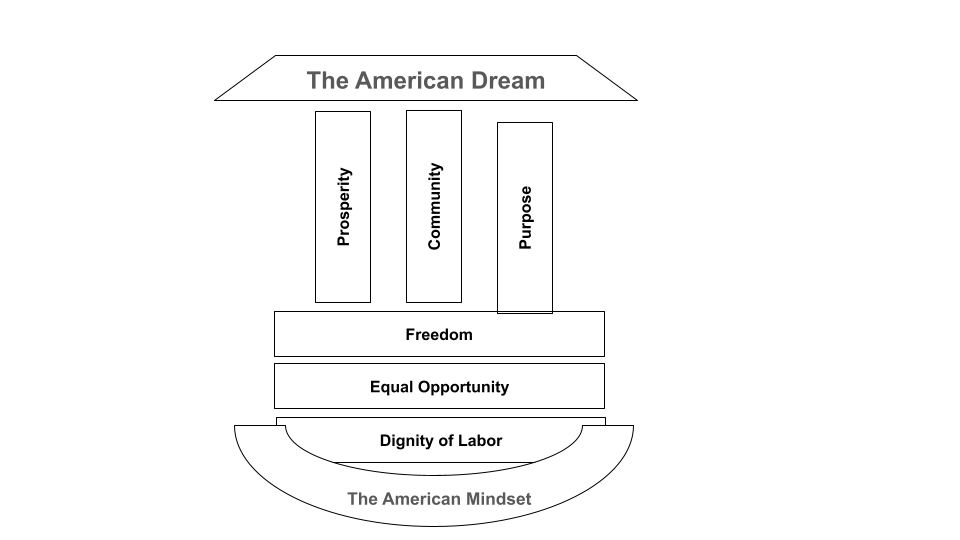
The three foundations of freedom, equal opportunity, and dignity of labor are the distinct American conditions that make the dream possible.
When Thomas Jefferson wrote the Declaration of Independence, he didn’t describe freedom as something a government could choose to give its citizens. He wrote that people were “endowed by their Creator with certain unalienable Rights” and that governments exist to secure those rights.
That distinction became deeply embedded in the American character. We value the freedom to think, speak, believe, disagree, and choose our own path. We are rightly skeptical of concentrated power precisely because history has proven time and again that no person or institution should have authority over the choices of others.
Freedom does not guarantee success. It gives us the opportunity to pursue it.
Abraham Lincoln captured the American promise of equal opportunity in his message to congress.
He spoke of removing “artificial weights” from people’s shoulders and giving everyone “an unfettered start, and a fair chance, in the race of life.” And at the Gettysburg address he reminded people of our founded ideals when he said “… conceived in Liberty, and dedicated to the proposition that all men are created equal.”
Lincoln did not promise that everyone would finish the race at the same time or arrive at the same destination. He spoke about the chance to run.
Martin Luther King Jr. expressed the third foundation, dignity of labor, beautifully when he said, “all labor that uplifts humanity has dignity and importance and should be undertaken with painstaking excellence.”
He stood before hundreds of thousands of people in Washington and spoke of a dream in which his children would be judged not by the color of their skin but by the content of their character.
That dream was about far more than ending racial discrimination.
It was also a vision of a society in which every person could live and work with dignity, judged by their character rather than the circumstances of their birth.
These ideas are deeply American.
These foundations form the solid ground upon which achievement stands. They enable a society where individuals are free to pursue their own path, where rights are viewed as God-given rather than granted by government, and where honest work is worthy of dignity and respect regardless of how much it pays.
From these foundations rise the three pillars of prosperity, belonging and purpose.
The ability to improve our condition, develop our talents, and build a better life is prosperity. It gives us security for our families, the freedom to pursue our ambitions, and the means to create possibilities for the next generation.
Belonging is the ability to form lasting relationships, make true friends, put down roots, and become part of a community. It is the feeling that we are not simply passing through life, but have a place where we are known, valued, and connected to others.
Finally, devoting ourselves to something meaningful, whether through family, faith, work, community, or service to others is purpose. It gives direction to our efforts and allows us to feel that what we do matters beyond ourselves.
Prosperity, belonging, and purpose reinforce one another. Each of us cultivates them differently, creating a balance that feels right for our own lives.
This is why the American Dream cannot be reduced to a paycheck or riches. A mansion isolated in the middle of a desert is not exactly what we imagine when we picture our future. We don’t imagine success while being completely alone. No parent dreams only of accumulating wealth; they dream of seeing their children flourish.
That also connects with what we saw when we discussed the paradox of achievement. What people truly desire is prosperity, connection, and contribution.
The final component is the American mindset which makes the pursuit of the dream unique.
A Pew survey6 conducted globally in 44 countries found that Americans are generally the most optimistic people in the world when it comes to their belief that they have agency over their future.
They tend to believe that individuals possess the ability to improve their circumstances no matter what their current standing, and that tomorrow can (or will) be better than today.
This optimism is not naïve. Americans do understand that luck, timing, family circumstances, connections, health, and countless other factors influence success.
Life is rarely a simple equation in which effort alone determines outcomes.
Yet, the core American mindset is to avoid being defined by circumstances beyond our control. We have traditionally believed that hard work, persistence, and the determination to overcome obstacles are among the most important ingredients of success.
This mindset is central to the American Dream and makes it unique.
This 3-3-1 framework of the three foundations, the three pillars, and the American mindset that underpins them is not just a reinvention of the American Dream, but a return to it.
That’s because the American Dream was about more than becoming richer. It was also about building a better and fuller life than the previous generation had the opportunity to live.
Next Chapter: The American Foundations
Previous Chapter: A Vision of the American Dream
Pingback: Chapter 6 - The American Foundations - The American Dream - Dancing The Digital Tune
Pingback: Chapter 4 - A Vision of the American Dream - The American Dream - Dancing The Digital Tune