
There’s a lot of doomsday predictions happening with AI. At the same time there are plenty who say it will solve a lot of our problems.
As per Elon, AI will bring an age of abundance, and there’s really no going back. And even if there was a kill switch, we shouldn’t press it. And as per Bill Gates, AI spells doomsday and we should stop it or regulate it while we can.
Like everyone else, I can’t stop thinking about what’s going to happen. More tangibly to my own career and to the next generation.
Overall, I find myself aligning with the “age of abundance” analogy. It seems far more plausible than the zero-sum doomsday prediction. However, I still don’t fully agree with Elon’s idea that everyone will simply receive a “universal high income” because that’s not where I think AI is taking us. We’ll tackle that in a later post..
Let me take a few examples and explain my thinking on 3 fronts.
1. Coding & Technology (and other white collar jobs)
Having used various agentic coding frameworks over the past few months, there’s no doubt that traditional coding as we know it is soon going to be obsolete. AI can do in 3-5x less time what we can do, and in many cases even 20x faster. Just like we don’t write in assembly language any more, I think that folks will simply not code anymore. They’ll use agents to analyze, code, and test. However much we try to resist it, that’s just the way things are going. The same is true of finance, or accounting, or medical transcription, or anything else.
So does that mean all the coders/analysts will be gone? Not really. Some will change what they do and some will be required to operate and engineer this new agentic model. Agents need to be told, and guided. AI is not creative, it’s just a predictive model because what matters is that humans still provide goals, judgment, context, accountability, and direction, even as machines perform more of the execution.
This is where the age of abundance concept kicks in. Our backlog of needs was shaped by human and cost limitations. With that constraint lifted to a large extent, a lot more work will now be accomplished. If a company doesn’t do that, it will simply be left behind.
With high productivity comes higher capacity to innovate and launch. All that tech debt holding us back, all those integration, data quality, and customer experience issues can now be tackled. Lots more financial deals and decisions have to be analyzed, and lots more data sources can be integrated to understand and predict business performance. And we will need people to help guide all that – using AI agents.
So fighting against agentic AI is not the play. Cost reduction is a feasible tactic but probably a losing strategy. Overall, in my opinion, reskilling and adapting both work & organizations is a better approach.
Disruption is coming. But it’s not doomsday. Just like we told all the travel agents in the year 2000. Some will not be able to adapt and change what they do, but most will.
2. Robots (and Blue Collar labor)
The second side of this story is blue collar jobs. Welding, lawnmowing, cooking, plumbing, Uber drivers, and so on,
Robots are coming to take over. It’s inevitable even though it’s still a few years in the future.
And here again I lean towards the age of abundance concept. Every person should think of themselves as either a robot owner, a robot operator, or a robot manager. For example, as a plumber I will own a robot that will do much of the work, I won’t lose that work. My value will be in investing in a robot as a business asset.
Overall my quality of life will increase. The important shift is that we are moving from ownership of labor to ownership of productive capacity. It’s a much different lens.
Work won’t end. More is accomplished. And we will need an entirely new industry to service the robots too.
Wait times will reduce. Even hospitals will process more patients as we are not limited by human capacity and cost constraints.
This could create millions of new small-scale business owners. Some people might own one robot. Others might operate fleets of tens or hundreds or thousands. Some will provide services to build and maintain the robots, and others will create businesses around deploying robots and robotic services to customers. And yet many more will be needed to handle all the other stuff that naturally happens – insurance, locked gates, damages etc.
The most important aspect of government regulation is not to prevent this wealth creation, it’s to make sure that competition is fair and not concentrated – just like it is done today.
So the zero-sum thinking fails here too. It’s not entirely wrong, but it misses the forest for the trees.
3. Risk to Humanity
Then there’s the 3rd angle that Bill Gates brought up recently. Robots and AI can be misused to wage biological and other warfare. Yes they will do that. Human ingenuity promises us that outcome. But no government regulation can stop it because if they could we wouldn’t have all of the deaths from illegal drugs and gang violence we have today.
For every Superman, there is a Lex Luthor.
We just have to roll with the punches and build better defenses. And AI will be a force for good because it’s a tool we can build and evolve much faster.
How to Prepare?
The only thing that is absolutely certain is that change is coming incredibly fast.
You can’t put the genie back in the bottle. Being in denial is not a good idea.
It’s best to prepare.
Think about it in these ways to adapt your mindset:
- Ford doesn’t just make cars, they provide transportation.
- Starbucks doesn’t just sell coffee, they provide a “third place”
- Citi doesn’t provide a credit card, they provide financial security
Same way, we don’t just write code, we create reliable and predictable innovation. A financial analyst doesn’t just produce spreadsheet models, they offer insights for a deal or an investment.
Move from:
- “I write code.”
- “I analyze financial statements.”
- “I drive a truck.”
To
- “I help innovate with technology.”
- “I help you make an investment decision.”
- “I help you move from A to B.”
It’s time to separate what AI can do from what we can do.
Good luck to all of us!
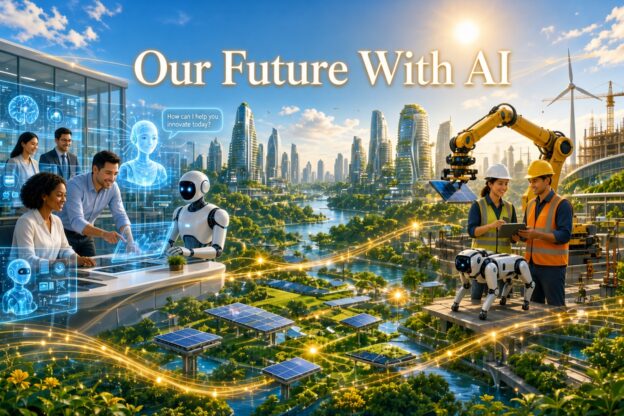
PS: Text is mine, image is AI (of course)…not great but does the job.